Over 300,000 German-speaking expatriates currently live in Spain, and a significant portion have settled along the Costa Blanca — yet fewer than half work with a qualified local tax advisor, leaving them exposed to costly compliance errors. Navigating Spanish tax law while managing obligations in Germany, Austria, or Switzerland is genuinely complex. A dedicated Costa Blanca Steuerbüro bridges that gap, offering bilingual expertise that protects expats, retirees, and property investors from unnecessary penalties and missed deductions.
Whether relocating permanently, owning a holiday property, or running a business from Alicante to Denia, understanding what a professional Costa Blanca Steuerbüro provides can save thousands of euros annually.
Key Takeaways 📌
- A Costa Blanca Steuerbüro (tax office/advisory firm) specialises in Spanish and cross-border tax matters for German-speaking clients.
- Expats must typically file Spanish income tax within six months of becoming tax resident (183+ days per year).
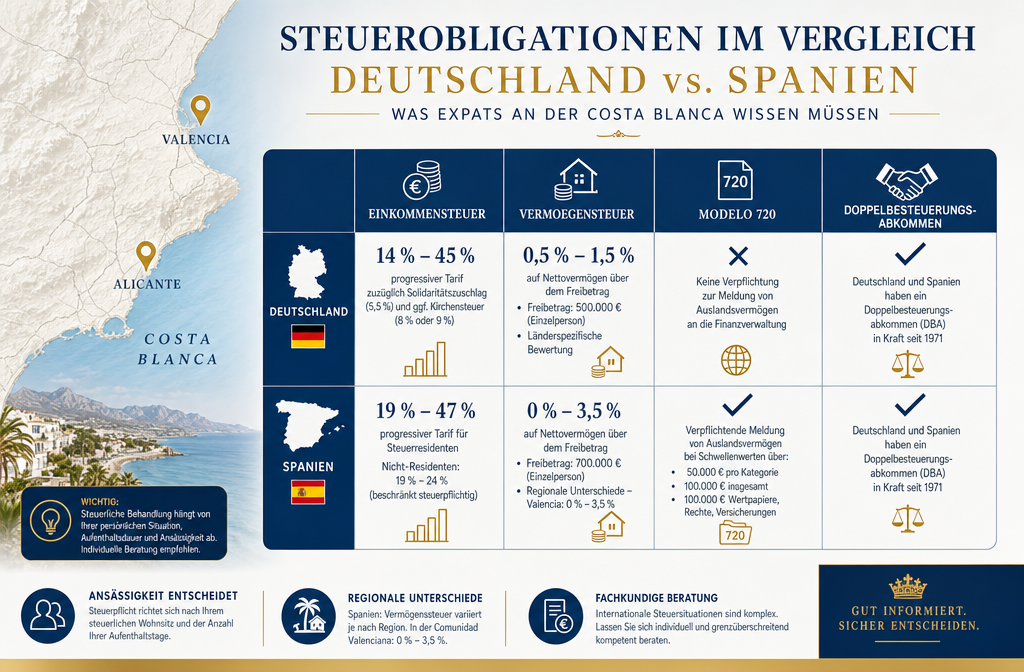
- The Modelo 720 asset declaration is a critical — and frequently overlooked — obligation for residents with foreign assets exceeding €50,000.
- Double taxation agreements (Doppelbesteuerungsabkommen) between Spain and Germany, Austria, and Switzerland prevent paying full tax in both countries.
- Choosing a bilingual Steuerberater or Gestor with local Costa Blanca experience dramatically reduces compliance risk.
What Is a Costa Blanca Steuerbüro and Who Needs One?

The term Steuerbüro (literally „tax office“) refers to a professional tax advisory practice. Along the Costa Blanca — the stretch of Mediterranean coastline running through the province of Alicante — these firms cater primarily to German, Austrian, and Swiss nationals who have bought property, retired, or established businesses in Spain.
The Typical Client Profile
A Costa Blanca Steuerbüro typically serves:
| Client Type | Primary Tax Concern |
|---|---|
| 🏡 Retirees | Pension taxation, residency status, wealth tax |
| 🏘️ Property investors | Rental income, capital gains, non-resident tax (IRNR) |
| 💼 Self-employed / freelancers | Autónomo registration, VAT (IVA), income tax |
| 🏢 Business owners | Corporate tax (Impuesto de Sociedades), payroll |
| 🌍 Cross-border workers | Double taxation treaties, split-year residency |
Why General Tax Knowledge Is Not Enough
Spanish tax law is layered and changes frequently. Many expats assume their German tax advisor can handle Spanish obligations remotely — this is rarely sufficient. Spanish-specific filings such as Modelo 100 (income tax), Modelo 210 (non-resident tax), and Modelo 720 (overseas asset declaration) require in-country expertise and awareness of regional regulations that apply specifically to the Valencian Community.
💬 „The Spanish tax system has its own logic. A local bilingual advisor does not just translate documents — they translate the entire regulatory environment.“
Core Services Offered by a Costa Blanca Steuerbüro
A well-established Costa Blanca tax advisory practice covers a wide range of services. Understanding these helps clients choose the right firm and ask the right questions.
1. Spanish Income Tax (IRPF — Impuesto sobre la Renta de las Personas Físicas)
Once an individual spends more than 183 days per year in Spain, they become a Spanish tax resident and must declare their worldwide income. This includes:
- German, Austrian, or Swiss pensions
- Investment income and dividends
- Rental income from properties abroad
- Capital gains from asset sales
A qualified Steuerberater or Gestor at a Costa Blanca Steuerbüro ensures all income streams are correctly declared, deductions are maximised, and the annual Declaración de la Renta is filed on time (typically April–June each year).
2. Non-Resident Tax (IRNR — Impuesto sobre la Renta de No Residentes)
Property owners who spend fewer than 183 days in Spain but own real estate on the Costa Blanca still owe non-resident income tax. This applies even if the property is not rented out — Spain imputes a notional rental income based on the valor catastral (cadastral value).
Key filing deadlines:
- Rental income: Quarterly (Q1–Q4)
- Imputed income (vacant property): Annual, by 31 December
3. Modelo 720 — Overseas Asset Declaration ⚠️
This is arguably the most misunderstood obligation among expats. Spanish tax residents must declare foreign assets — bank accounts, investments, real estate, insurance products — exceeding €50,000 per category. Failure to file or filing incorrectly can result in severe penalties.
A reputable Costa Blanca Steuerbüro will:
- Assess whether the threshold is met
- Prepare and submit the Modelo 720 by 31 March each year
- Advise on subsequent years when only changes above €20,000 trigger a new filing
4. Wealth Tax (Impuesto sobre el Patrimonio)
Spain levies a wealth tax on net assets above a certain threshold. The Valencian Community (which covers the Costa Blanca) has its own regional rules and exemptions. In 2026, this remains an active obligation for high-net-worth residents and non-residents with significant Spanish property holdings.
5. Double Taxation Agreement (Doppelbesteuerungsabkommen) Advice
Spain has signed double taxation treaties with Germany, Austria, and Switzerland. These agreements determine which country has the primary right to tax each income type. A skilled Costa Blanca Steuerbüro advisor navigates these treaties to:
- Avoid double taxation on pensions and investment income
- Claim foreign tax credits where applicable
- Structure income declarations optimally across both countries
6. Autónomo Registration and Self-Employment Tax
Freelancers and self-employed professionals must register as autónomo with Spain’s Social Security system and the tax authority (Agencia Tributaria). Monthly autónomo contributions, quarterly VAT returns, and income tax instalments all require careful management.
How to Choose the Right Costa Blanca Steuerbüro
Not every tax firm on the Costa Blanca is equally qualified to handle cross-border German-Spanish tax matters. Here is what to look for:
✅ Checklist: Evaluating a Costa Blanca Tax Advisor
- Bilingual fluency in German and Spanish (and ideally English)
- Registered with the Colegio de Gestores Administrativos or holds a recognised Steuerberater qualification
- Demonstrable experience with Modelo 720, IRPF, and IRNR filings
- Knowledge of German-Spanish double taxation treaties
- Clear, transparent fee structure (flat fees vs. hourly rates)
- Local office presence in key Costa Blanca towns (Alicante, Torrevieja, Benidorm, Denia, Jávea)
- Positive client references from German-speaking expats
Red Flags to Avoid 🚩
- Advisors who are unfamiliar with Modelo 720 obligations
- Firms that offer „one-size-fits-all“ packages without reviewing individual circumstances
- No clear professional registration or credentials
- Promises of tax outcomes that sound too good to be true
Understanding Fees
Fees at a Costa Blanca Steuerbüro vary depending on complexity:
| Service | Typical Fee Range (2026) |
|---|---|
| Basic IRPF declaration | €150 – €350 |
| Modelo 720 preparation | €200 – €500 |
| Non-resident tax (IRNR) | €100 – €250 per property |
| Autónomo monthly management | €80 – €200/month |
| Full cross-border tax planning | €500 – €2,000+ |
Key Tax Deadlines for Costa Blanca Expats in 2026 📅
Staying on top of filing dates is essential. Missing deadlines triggers automatic surcharges.
- January–March: Modelo 720 preparation window opens
- 31 March: Modelo 720 deadline
- April–June: Annual IRPF (Declaración de la Renta) filing period
- Quarterly: VAT (IVA) and income tax instalments for autónomos
- 31 December: Non-resident imputed income tax (Modelo 210) deadline
Conclusion: Take Control of Your Tax Situation on the Costa Blanca
Living or investing on the Costa Blanca offers exceptional quality of life — but the tax obligations that come with it are real and consequential. Working with a qualified Costa Blanca Steuerbüro is not an optional luxury; for most German-speaking expats and property owners, it is the single most important financial decision they can make after arriving in Spain.
Actionable Next Steps ✅
- Determine your tax residency status — count your days in Spain over the past 12 months.
- Audit your foreign assets — check whether your overseas bank accounts, investments, or property exceed the Modelo 720 threshold.
- Request consultations with at least two local bilingual tax advisors — compare credentials, experience, and fee structures.
- Gather key documents — German/Austrian/Swiss pension statements, property deeds, bank account details, and previous tax returns.
- Act before deadlines — the Modelo 720 window and the IRPF season both have firm cut-off dates with no extensions.
The right Costa Blanca Steuerbüro partner turns a complex, stressful obligation into a manageable, optimised process — protecting both your finances and your peace of mind under the Mediterranean sun. ☀️